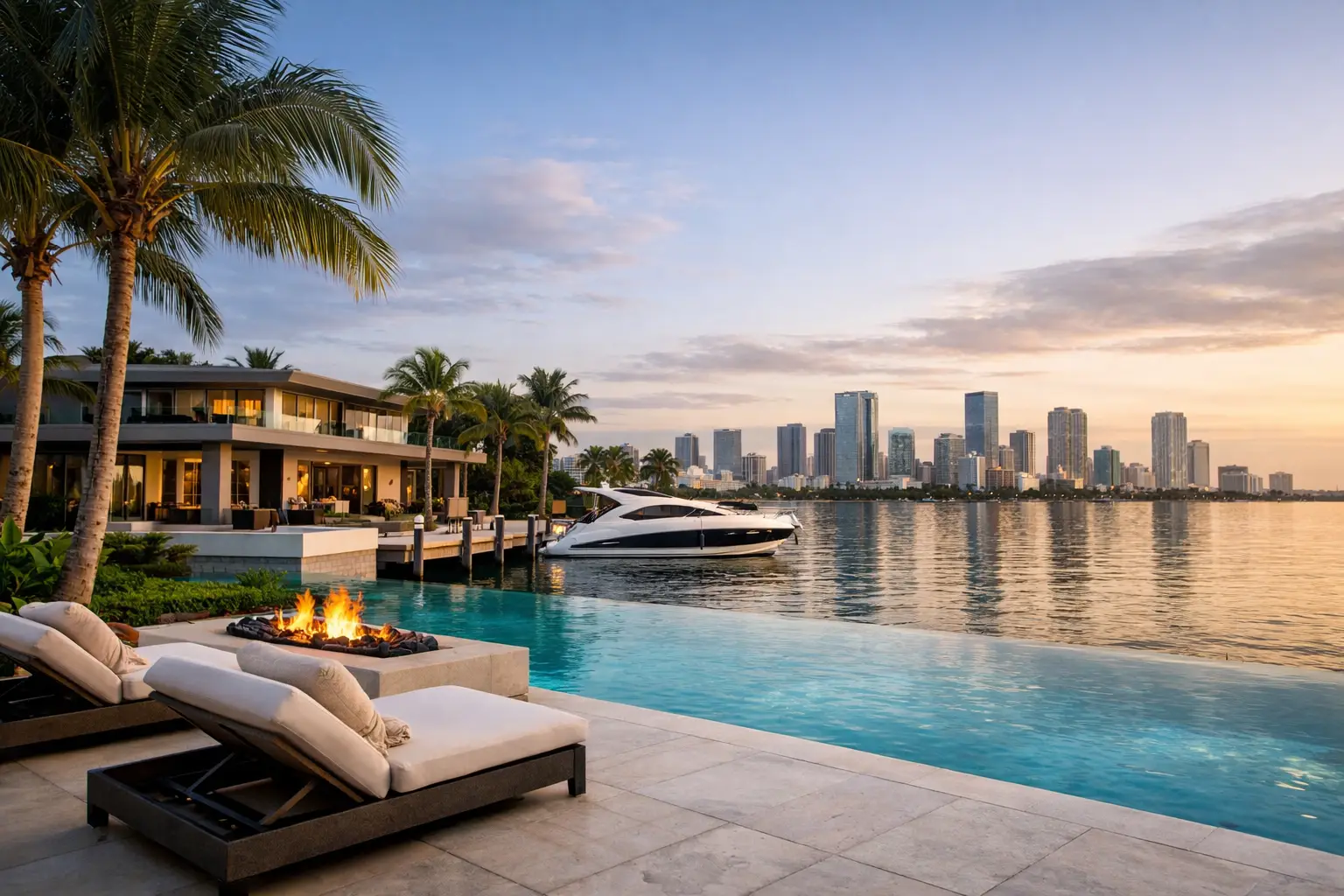
In Miami, luxury isn't measured solely by square footage, water views, or a recognizable address. In the truly high-end segment, luxury homes in Miami are valued by a much more demanding combination: real scarcity, market position, distinctive architecture, privacy, heritage preservation potential, and future exit potential. That's where a transaction stops being a basic real estate deal and becomes a strategic decision.
Miami has established itself as one of the most watched residential markets by international buyers, family offices, entrepreneurs, and global wealth. However, it's important to separate the noise from the value. Not every expensive property is a premium property, and not every premium property maintains its price strength over time. That difference matters, especially when buying to preserve capital or when selling with the legitimate expectation of sustaining a high valuation without entering into a discount dynamic.
What truly distinguishes luxury homes in Miami
The first factor is location, but at this level, it’s not enough to simply say Brickell, Coconut Grove, Coral Gables, Miami Beach, or Key Biscayne. What really matters is the micro-market. The specific street, the orientation, the waterfront access, the lot depth, privacy from neighbors, and the quality of the immediate surroundings completely change a home’s standing in the market. Two propiedades homes within the same area can have a very significant difference in value if one offers actual boat access, greater seclusion, better views, or architecture that is harder to replicate.
The second factor is uniqueness. The premium market punishes generic housing, even when priced high. In contrast, it rewards residences with coherent design, layouts suited for an international lifestyle, and finishes that aren't driven by fleeting trends. A well-conceived luxury home in Miami understands how people live there: integration between indoor and outdoor spaces, functional privacy, entertainment areas, wellness facilities, a dock if applicable, effective home technology, and an impeccable understanding of the climate and light.
The third element is future liquidity. It may seem like a secondary concern when buying, but it's not. In high-end residences, exit strategy matters from day one. A highly personalized property can be extraordinary for a specific owner and, at the same time, slower to sell. Conversely, an exceptional yet commercially smart home better retains its appeal for the next sophisticated buyer. True luxury doesn't just impress. It also endures.
Enclaves that concentrate premium interest
Miami does not function as a uniform market. It functions as a sum of very distinct enclaves, each with its own logic of value. Miami Beach remains an undisputed benchmark for those who prioritize international exposure, waterfront, and proximity to top-tier hospitality. However, within that universe, there are clear differences between areas with a more social profile, areas with greater privacy, and streets where scarcity carries more weight than notoriety.
Coral Gables offers a distinct proposition. Here, luxury tends to be more institutional, more established, and in many cases, more stable. There are buyers who value precisely that: residences with presence, generous lots, a consolidated environment, and a less market-spectacle-dependent lifestyle experience. Coconut Grove, on the other hand, has reinforced its position among those seeking less obvious sophistication, greenery, contemporary architecture, and a more serene relationship with the city.
Key Biscayne maintains a unique appeal for families and high-net-worth individuals who prioritize security, an island environment, and quick access to key Miami locations. In very high-end segments, each of these locations can work, but not for the same type of buyer or investment strategy. That nuance is decisive.
Not all waterfront property is worth the same.
The by the water It remains one of the major drivers of the luxury market in Miami, although it’s best to avoid oversimplifications. Being on the water does not automatically mean you have the best property. Factors such as the type of canal or bay, the draft, access to the ocean, wind exposure, visual privacy, and surrounding boat traffic all matter. It also matters whether the home truly takes advantage of that location or simply highlights it in its marketing materials.
In a very premium propiedades project, a well-executed waterfront adds exclusivity and strengthens the project’s positioning. If poorly executed, it can become a superficial selling point that does not justify the intended premium.
Buying well requires more than just a budget
In this market, having capital doesn't guarantee a good purchase. The most common mistake among international buyers is confusing visibility with opportunity. The best homes aren't always the most widely advertised, and many high-profile properties hit the market with price expectations that are difficult to justify. Shop Smart It requires discernment to determine which part of the price reflects the actual value and which part is due to the seller's expectations, the listing description, or current market conditions.
It also requires an understanding of the hidden costs of a poor choice. A spectacular home with a poor layout, complex maintenance, or a less liquid location may seem like a great purchase until the time comes to resell it. The luxury market is less forgiving than it seems. When the property isn’t well chosen, the future discount is often more costly than any apparent savings on the initial purchase.
For the discerning buyer, the question shouldn't be just whether they like the property. It should be whether the property is worth the price, whether its scarcity is justifiable, and whether its appeal will still hold up in five or ten years.
Selling Luxury Homes in Miami Without Depreciating the Asset's Value
Selling a premium residence requires a very different approach than conventional real estate brokerage. Overexposing a property, listing it at an inflated price, and then downplaying or trivializing its uniqueness through mass marketing tends to undermine its value. In the luxury market, the perception of value is part of the value itself.
A well-represented property requires strategic pricing, the right narrative, international segmentation, and control over how it is presented to the market. It’s not about reaching everyone. It’s about reaching the right few, in the right context, and with a pitch that justifies the premium. That work requires experience, sound judgment, and a clear defense of the owner’s interests.
Here lies an uncomfortable truth for the industry: many high-end propiedades properties are marketed as if they were standard products, complete with excellent photos. That’s not enough. An asset in this category needs to be showcased—not just listed. BUCKINGHAM Property Advisors operates on this principle: protecting the owner’s position and maximizing the asset’s value through selective, international marketing.
The right price isn't necessarily the highest one on paper
In aspirational markets, setting a price that’s too high may seem like a sign of strength. In practice, it often weakens the sale. Sophisticated buyers are familiar with market benchmarks, compare transactions, quickly recognize when a property is out of range, and rarely act on impulse. When a premium home stays on the market too long, it begins to lose its appeal.
The right price is one that allows you to highlight the property’s unique qualities without turning the sale into a never-ending negotiation. That requires an understanding of the market, not sales hype.
Trends That Are Redefining Residential Luxury in Miami
Today’s international buyer seeks greater privacy, greater security, and a better quality of life. This has fueled demand for high-end turnkey residences, wellness spaces, private offices, truly functional kitchens, intuitive home technology, and outdoor areas designed for entertaining without unnecessary exposure.
There is also a growing appreciation for architecture with character. A home that is too neutral may be comfortable, but it does not always create distinctive value. A home that is excessively eccentric may attract attention, but it can reduce the future demand base. Between these two extremes lies the well-balanced premium property: memorable, elegant, and commercially sound.
Another significant change is the increased sophistication of buyers. Today, buyers scrutinize construction quality, the resilience of the property, and the maintenance costs and its competitive position relative to other residences in the same area. Luxury remains an emotional concept, but it is increasingly backed by analysis.
A financial decision, not an impulse buy
Luxury homes in Miami continue to attract international capital for obvious reasons: climate, lifestyle, connectivity, favorable taxation in some cases, and iconic residential offerings. But the real value isn't in the postcard. It lies in choosing or selling with discernment, understanding which assets are truly scarce, which maintain their prestige, and which only seem premium while the market is favorable.
When a transaction is approached from an asset management perspective, luxury ceases to be a label and becomes a status symbol. And at this level, it is that distinction that safeguards long-term value.