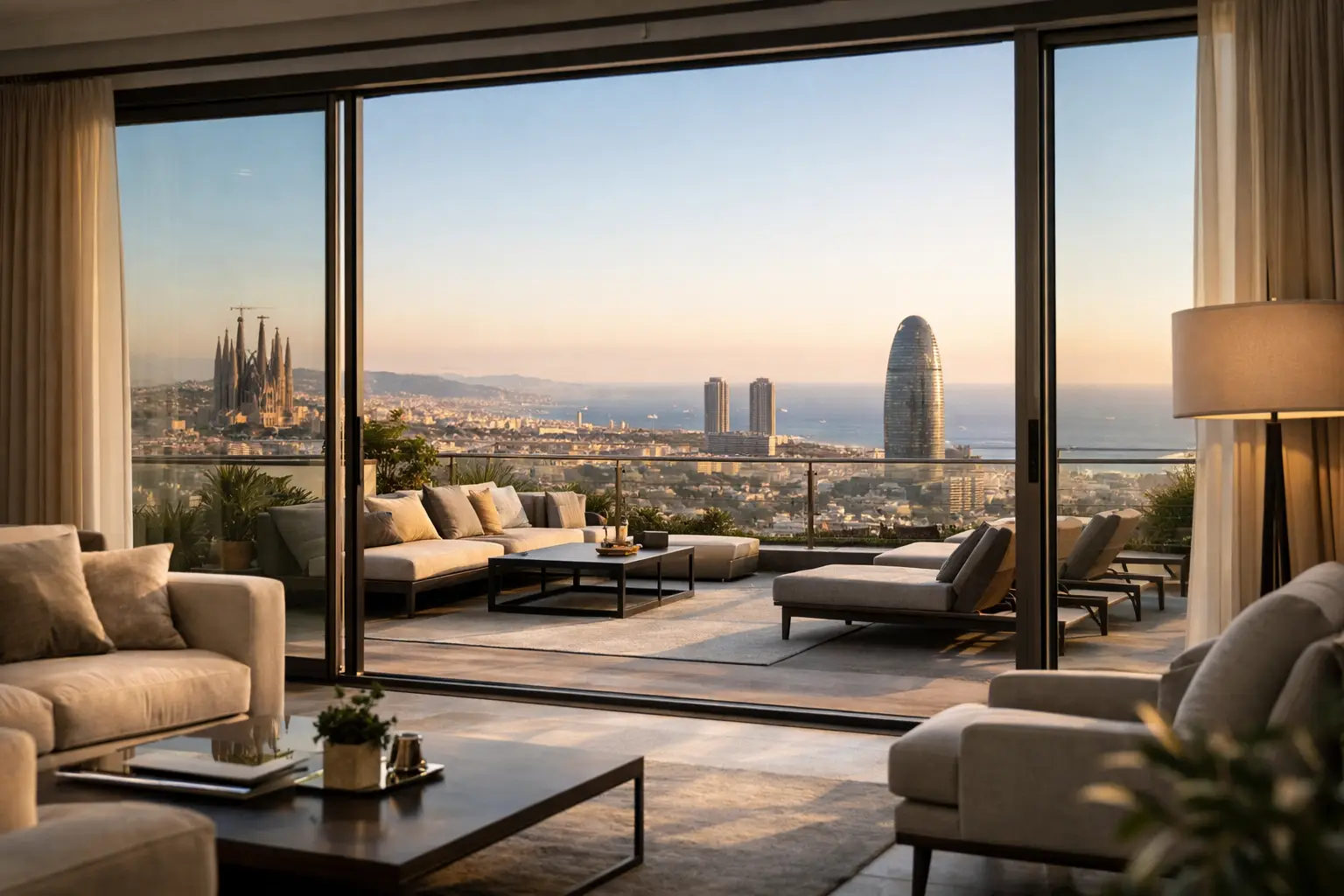
Some purchases can be finalized with a single visit and offer, while others, particularly those involving assets, require a different level of consideration. Buying a luxury apartment in Barcelona clearly falls into the latter category. In this city, the difference between a good deal and a truly exceptional acquisition usually lies not in the square footage, but in the genuine scarcity of the asset, the quality of the building, the precision of the location, and the ability to negotiate without compromising long-term value.
Barcelona continues to hold a unique position within the European premium residential market. It combines historic architecture, waterfront, neighborhoods with a very defined identity and an international liquidity that few urban destinations in Southern Europe can consistently sustain. But precisely for that reason, it is not enough to identify an attractive property. The sophisticated buyer needs to understand what they are paying for, why that asset deserves a premium, and in which cases a prestigious address does not guarantee a successful purchase.
What does buying a luxury apartment in Barcelona really mean?
In the high-end segment, luxury isn't just defined by price. An apartment can have a high price tag and still not be a prime asset. True value is usually concentrated in a scarce combination: established location, privacy, architectural quality, views, natural light, height, a terrace, a well-considered renovation, and a building that matches the product.
Barcelona offers several micromarkets within the luxury segment, each catering to different priorities. Pedralbes signifies discretion, spaciousness, and a patrimonial profile. Turó Park and the "zona alta" attract buyers who prioritize residential elegance, family life, and value continuity. The Right Eixample appeals with its classical architecture, centrality, and international prestige. Diagonal Mar and the seafront better suit a global buyer seeking amenities, open views, and a more contemporary experience.
A common mistake is to buy based on the neighborhood, when in reality you should buy based on the property itself. Two propiedades properties in the same area can have radically different investment profiles. The orientation, the exact stretch of the street, the quality of the building, the presence of noise, the scarcity of comparable units, and the resale potential all play just as big a role as the ZIP code.
Where to buy a luxury apartment in Barcelona based on your profile
Not all buyers are looking for the same thing, and that difference completely changes the strategy.
If the goal is a primary residence, the decision usually revolves around privacy, security, international schools, accessibility, and daily quality of life. In that context, the "zona alta" (upper zone/upscale area) maintains a dominant position. There is more urban tranquility, better-designed buildings for families, and a sense of permanence that asset-buying purchasers usually value.
If the priority is a second home or a pied-à-terre with a strong aesthetic component, Eixample and certain unique buildings in the city center have a clear advantage. High ceilings, restored original features, spacious balconies, and proximity to high-end dining, culture, and shopping create a proposition that is very difficult to replicate in other Mediterranean capitals.
If the purchase has an investment focus, the analysis should be less emotional. It is advisable to study the depth of international demand, future supply, urban planning restrictions, repositioning costs, and the asset's capacity to sustain rents or appreciate in value. In luxury real estate, overpaying for a very beautiful but illiquid apartment is a real possibility. The premium market rewards uniqueness, but penalizes poorly calibrated whims.
The price doesn't always reflect the value
In Barcelona, as in any sophisticated market, there is often a gap between the asking price and the justifiable value. In the propiedades prime segment, that gap may be justified by scarcity. In other segments, it reflects the seller’s expectations rather than market reality.
Therefore, it's advisable to analyze three layers. The first is the intrinsic value of the property: layout, light, condition, facade, views, floor, and amenities. The second is the relative value compared to truly similar properties, not compared to any listing in the same neighborhood. The third, and most decisive, is the strategic value: if that specific unit is difficult to replace within its segment.
An attic with a terrace in a prime section of Eixample, for example, should not be judged the same as a renovated main floor on the same avenue. Likewise, a property in an impeccable building in Pedralbes can justify a premium over another of similar size in a building without presence, even if the interior appears to be nice. In luxury, the container is as important as the content.
The quiet due diligence that makes the difference
Aesthetics sell, but documentation protects. Before moving forward, the discerning buyer must rigorously review the elements that rarely appear in photographs.
The registry and cadastre situation must be perfectly aligned. It is also necessary to confirm encumbrances, urban planning restrictions, the status of the community, foreseen special assessments, statutory limitations, licenses in case of previous major renovations, and any condition that alters the use or the future broadcast. In classic buildings, it's also advisable to realistically study the structure, installations, elevator, efficiency, and maintenance costs.
Here’s an uncomfortable truth: some of the most attractive propiedades properties on the premium market require a more complex technical analysis than conventional homes. That doesn’t make them any less desirable, but it does call for expert advice. A smart purchase isn’t the quickest one, but the one that stands the test of time.
Negotiate in luxury without devaluing the asset
Negotiating well doesn't mean forcing a discount at any cost. In high-end residential real estate, a bad negotiation can close doors, damage the relationship between parties, or even remove assets from the market that won't reappear. The key is to distinguish when there's real room for negotiation and when the price reflects a scarce asset with solvent demand.
The sophisticated buyer must come to the table with arguments, not impulses. Knowing comparables, exposure times, the quality of alternative offerings, and opportunity cost allows for a solid position without trivializing the transaction. In certain cases, agility, payment structure, or certainty of closing carry more weight than an aggressive discount.
This point is particularly relevant in Barcelona, where many premium propiedades brands operate in niche markets and do not always enjoy widespread exposure. Accessing opportunities outside the mainstream spotlight can be just as valuable as negotiating the final price.
Buying to live or buying to preserve heritage
Although both motivations can coexist, they are not exactly the same. The buyer who prioritizes lifestyle may accept certain compromises if the property creates an immediate connection. The wealth investor, on the other hand, usually demands stricter capital preservation logic.
That affects the choice of property. There are extraordinary apartments to enjoy that aren’t necessarily the most efficient from a wealth-building perspective. The opposite is also true: some propiedades units are very solid in terms of retaining value but may not offer the most striking visual appeal on a first visit.
The smart decision begins by defining the real purpose of the purchase. If the answer is ambiguous, the process becomes complicated. On the other hand, when the mandate is clear, the search becomes more precise and the negotiation gains consistency.
What does the international buyer expect today?
The global client no longer just buys location. They buy legal certainty, discretion, service, and execution capability. They value well-maintained buildings, move-in ready interiors, integrated home technology, reasonable efficiency, and a frictionless acquisition experience.
It also pays close attention to the asset's narrative. It's not enough for a property to be expensive. It must be defensible. It must have market logic, uniqueness, and a clear position within its segment. This is where a firm like BUCKINGHAM Property Advisors understands that representing a premium transaction is not about opening doors, but about filtering, interpreting, and protecting interests with strategic judgment.
The most expensive mistakes when buying a luxury apartment in Barcelona
The first is confusing visibility with quality. Just because a property is prominent doesn't mean it's the best asset available. The second is paying for a flashy renovation without analyzing the building's value structure and exact location. The third, very common, is giving in to urgency in a market where patience is often a competitive advantage.
It's also advisable to avoid the bias of international buyers who compare Barcelona to other capitals and automatically assume everything seems cheap. This perception may be true in relative terms, but it doesn't invalidate purchasing discipline. A poorly bought asset remains a poorly bought asset, even within a city with strong global appeal.
Buying well in Barcelona demands a selective and serene approach. The best deals are rarely the most obvious, and true luxury isn't about acquiring quickly, but about choosing a property capable of maintaining prestige, utility, and value with the same solidity in ten years' time.